Lionel and Julia’s Lighthouse Standoff
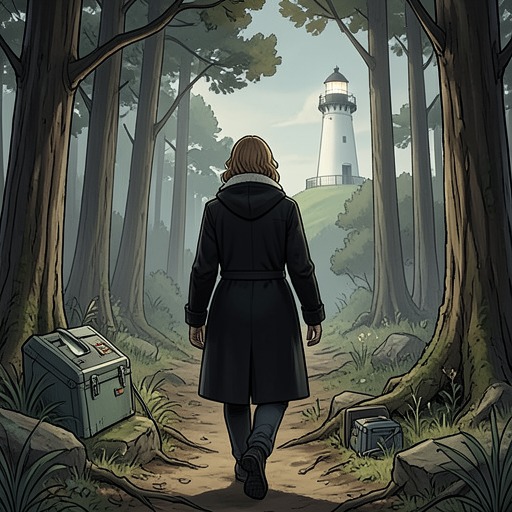
Motherless BrooklynLionel and Julia’s Lighthouse Standoff is the armed confrontation at Friendship Head Lighthouse in which Lionel Essrog and Julia Minna point guns at one another, then choose not to fire. The exchange begins in mistrust over the Giant Killer and the fate of Gerard Minna, but ends with Lionel throwing both weapons into the sea and casting away other objects connected to the case. Its decisive turn is not a victory over an opponent: it is Lionel interrupting the violence before either of them becomes its next casualty.
Causes and Setting
The confrontation follows Lionel’s statement that Tony Vermonte was found by the killer before he could reach Fujisaki, and that Gerard would not be saved by this. Julia asks what Lionel means. He answers by questioning whether the Giant Killer exists at all, challenging her account as possibly imagined. The dispute puts their opposed understandings of the danger directly between them: Julia has been speaking of the killer, while Lionel insists that the threat is real even as he pretends to doubt her.
The exchange briefly shifts when Julia offers Lionel a cigarette to light. Lionel notices a vibration in her voice and thinks she may be about to mourn Frank Minna, this time without anger. Before he finishes lighting it, however, Julia takes a gun from her purse. The offer of an ordinary shared gesture gives way almost immediately to an armed standoff, and Lionel’s reading of her grief remains an uncertain impression rather than a reconciliation.
Two Guns, Neither Shot
Julia points her gun at Lionel. He raises his hands, both in a pose of surrender and in instinctive self-protection, while imagining Frank’s watch as if it could serve as a shield. Her expression is difficult for him to read. Lionel feels the physical force of fear and wonders whether getting accustomed to being held at gunpoint is anything worth wanting. The scene makes the danger concrete without turning it into an exchange of fire.
Julia compares the Giant Killer to Snuffleupagus, the character only Big Bird can see, and suggests that Lionel’s giant may likewise be imaginary. Lionel rejects the comparison and tells her to put the gun away. When she refuses and tells him to step back, he does so while drawing Tony’s gun. Julia’s fingers tighten, but neither fires. They stand with the dimming sky and ocean around them, yet the two guns narrow the moment to the choices each has made. Lionel recognizes that his weapon is not an ordinary object and removes its safety; its attraction and his sense of control sharpen even as the scene threatens to become fatal.
He then shouts a plea for Julia to trust him, directing it into the sky. His Tourette syndrome has begun to fixate on pulling the trigger, and he fears that firing even a shot into the air might not be something he survives. He does not want to shoot Julia. He quietly puts the safety back on and hopes she does not notice. When she asks where they go from there, he answers that they go home, that the story is over, and that both have made it through alive. The claim of an ending comes before the danger has fully passed; Lionel still has to act on it.
Disarming the Scene
Before his finger can act on its urge to pull the trigger, Lionel hurls Tony’s gun toward the ocean. Julia has time to register the gesture, but not to calculate its meaning before he moves for her weapon. He grabs its muzzle, twists it from her hand, and throws it farther out, toward the waves forming beyond the rocks. The actions change the encounter from two people threatening one another to one person deliberately removing the means of attack. Julia backs away, visibly shocked and still fearful and angry. Lionel tells her that it is over and that nobody will hurt her.
His decision extends beyond the guns. Lionel takes Minna’s beeper from his pocket and throws it away because it is a tool of The Clients and evidence of their hold on Frank. The beeper does not reach the water; the wind knocks it between wet, mossy boulders. That imperfect disposal matters to the sequence: renunciation is an action, but it does not make every trace vanish on command. He next takes a cell phone. Although Kimmery’s number tempts him to dial, he pushes aside the impulse and throws the phone from the lighthouse deck, picturing the doormen in the rental car from whom he had taken it. The phone travels out to the water.
What Lionel Leaves Behind
Lionel’s discards become a counted series. After throwing the two guns and the beeper, he casts away the cell phone; later he removes his polished right shoe, notices its fine stitching and fraying lace, kisses the top of its tongue, and throws it high and far into the waves. The shoe differs from the weapons and devices: it is something that has served him well, and his farewell gives the act a personal rather than investigative weight. By the time he reaches the count of five, the sequence has become a deliberate physical separation from what he has been carrying.
The standoff also turns Lionel’s remembered principle of choosing which battles matter into conduct. He connects that choice with distancing oneself from cruelty, and judges that he is beginning to acquire the sense to do so. He does not settle the dispute about the Giant Killer by force, expose Gerard in this moment, or recover Frank. Instead, he prevents the immediate confrontation from adding another death and tells Julia they can go home. The guns and discarded objects make that decision visible: the case’s violence and obligations have not all been resolved, but Lionel refuses to let this particular encounter dictate what happens next.